REST or event-driven integration? 3 decision questions for choosing the right integration pattern
Many teams decide between REST and event-driven integration too early and for the wrong reasons. Sometimes because an organisation already runs many APIs and automatically reaches for REST. Sometimes because event-driven sounds "more modern" and almost by default becomes the preferred direction. Both reflexes are too simple.
The right choice doesn't depend on hype or preference — it depends on how the process actually behaves. Does a consumer need an immediate answer? Must multiple systems react to the same event? And can processing happen asynchronously without the business or user experience suffering?
Those questions determine how tightly systems become coupled at runtime, how failures propagate, how much operational discipline is needed, and how well the landscape scales over time. What follows is a practical decision framework that makes that trade-off explicit and defensible.
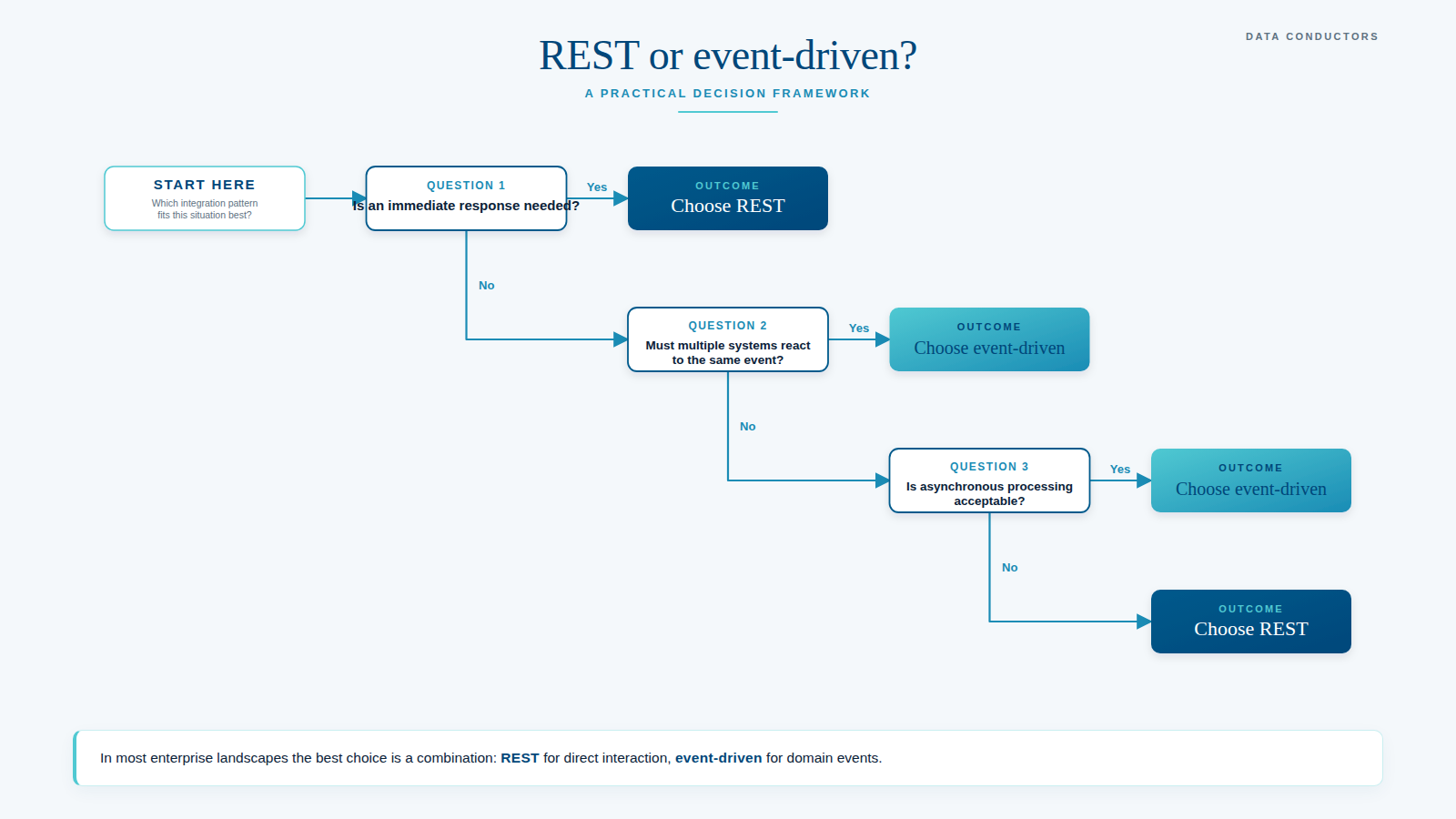
The decision tree above gives the quick overview. In the rest of this article we work through the three questions in detail, including the nuance that makes the real difference in most enterprise landscapes: the best answer is rarely either REST or event-driven, but a deliberate combination of both.
Question 1 — Is an immediate response needed?
The first and often most important question is whether the consumer needs an answer right away in order to move on. When a user is working in a screen, a process needs immediate confirmation, or a system cannot take the next step without a current response, that usually points to REST.
This pattern is the natural fit for situations such as:
- validating input during a transaction;
- retrieving current status or reference data;
- a front-end that must show product or customer information right now;
- a command action whose outcome must be visible immediately.
REST fits well here because the model is simple and explicit. A consumer asks a question, a service answers, and status codes plus error messages make behaviour directly observable. That helps both functionally and operationally: failures surface immediately and are usually easier to reproduce than in asynchronous chains.
But there's a well-known trap. Many organisations make everything synchronous "for convenience", even though not every process actually needs immediate feedback. The result is chains where service A waits on B, B on C, and C on D. That works as long as everything is healthy — but the moment one link slows down or fails, the whole chain feels it instantly.
So the question isn't only whether an immediate response is desirable, but whether it's truly a hard requirement. If the answer is yes, REST is often the right choice. If the honest answer is no, then synchronous behaviour quickly becomes a source of unnecessary coupling.
Question 2 — Must multiple systems react to the same event?
The second decision question is about fan-out. If a single change or event is relevant to multiple consumers, point-to-point integration quickly becomes unwieldy. The producer then has to know, call, and keep alive ever more consumers — while coupling should actually decrease as the landscape grows.
This is where event-driven integration is usually stronger. Instead of calling multiple systems directly, a producer publishes a single event, after which multiple consumers can react independently.
Think of events like:
- an order was placed;
- a customer profile was updated;
- a campaign was activated;
- a document was approved.
A fact like that can be relevant to several consumers at once: notifications, analytics, fulfilment, CRM enrichment, or downstream synchronisation. With a broker or event bus, the producer doesn't need to know every consumer explicitly. That lowers direct dependencies and makes extension easier.
That benefit doesn't come for free. Event-driven integration works well only when the basics are in place:
- consumers must be idempotent;
- delivery failures must be handled properly;
- events must be stable and versionable;
- observability must span systems;
- ownership of source data must stay clearly defined.
Without those preconditions, event-driven doesn't become a scalable pattern — it becomes an opaque landscape where much happens but nobody knows exactly where an effect came from or why something got processed twice.
The practical rule of thumb: when multiple systems must react to the same event, event-driven deserves serious preference. Not because it's fashionable, but because the pattern matches what actually happens: one fact, multiple consequences.
Question 3 — Is asynchronous processing acceptable?
The third question is about time. Not every process has to finish immediately. Many actions may be processed downstream seconds or even minutes later, as long as that is a deliberate design choice and remains acceptable for the business.
That's exactly where event-driven integration shines. When a caller doesn't have to wait on every follow-up step, the chain becomes more robust. Temporary downstream disruptions don't immediately block the producer. Buffers, retries, and reprocessing can do their work without the initial action breaking.
That makes a big difference in production. A synchronous chain is often only as strong as its weakest link: if one service falls away, the whole request chain feels it. In an asynchronous model the producer can usually keep going, while consumers catch up or retry later.
But asynchronous processing is only acceptable when:
- eventual consistency is functionally defensible;
- users don't need to see a final outcome immediately;
- downstream actions may happen later;
- the process makes clear what "accepted" means versus "fully processed".
As soon as a user or process does need immediate certainty, asynchrony becomes confusing rather than helpful. Then you end up with awkward workarounds: polling, status screens, pseudo-synchronous event paths, or unclear business states.
The essence of this third question is therefore simple: if time-decoupling is acceptable, that expands the space for event-driven design. If it isn't, you quickly end up back at a synchronous approach like REST.
Nuance: in practice, often a combination
The most important design message is that mature enterprise landscapes are rarely fully REST-first or fully event-first. In practice, a combination usually works best.
A typical pattern is:
- REST for direct command paths and interactive processes;
- event-driven for distributing domain events to downstream systems.
Take order processing, for example. A front-end or order service can confirm synchronously via REST that an order has been received and accepted. The same service can then publish an event asynchronously, so fulfilment, analytics, notifications, and billing all react to it. The user gets immediate feedback while the landscape stays loosely coupled downstream.
That tends to be architecturally much healthier than trying to make everything synchronous or everything asynchronous. The question isn't which pattern "wins" — it's which pattern supports the right behaviour at the right point in the chain.
The best choice is usually:
- synchronous where immediate certainty is required;
- asynchronous where decoupling, scale, or multiple consumers matter more.
Summary: the three decision questions
When you have to choose between REST and event-driven integration, don't start with technology or preference. Start with three questions:
- Does the consumer need an immediate response?
- Must multiple systems react to the same event?
- Is asynchronous processing acceptable?
Those three questions alone make it much clearer which pattern is architecturally sound. They help replace loose opinions with explicit design trade-offs — exactly what's needed in enterprise environments where systems, teams, and interests come together.
At Data Conductors we use decision frameworks like this to design integrations that don't just work, but stay manageable. Because the cheapest connection is rarely the one that stays the most adaptable over time.