Integration architecture for robotic fulfilment
From automation to a scalable enterprise landscape
From automation to a scalable enterprise landscape
This case relates to the publicly announced collaboration between Albert Heijn and Swisslog around automated Home Shop Centers. In Barendrecht, an integrated Swisslog solution with AutoStore, SynQ software and robots was introduced to automate a significant part of online grocery order picking. The model was later extended to Zwolle.
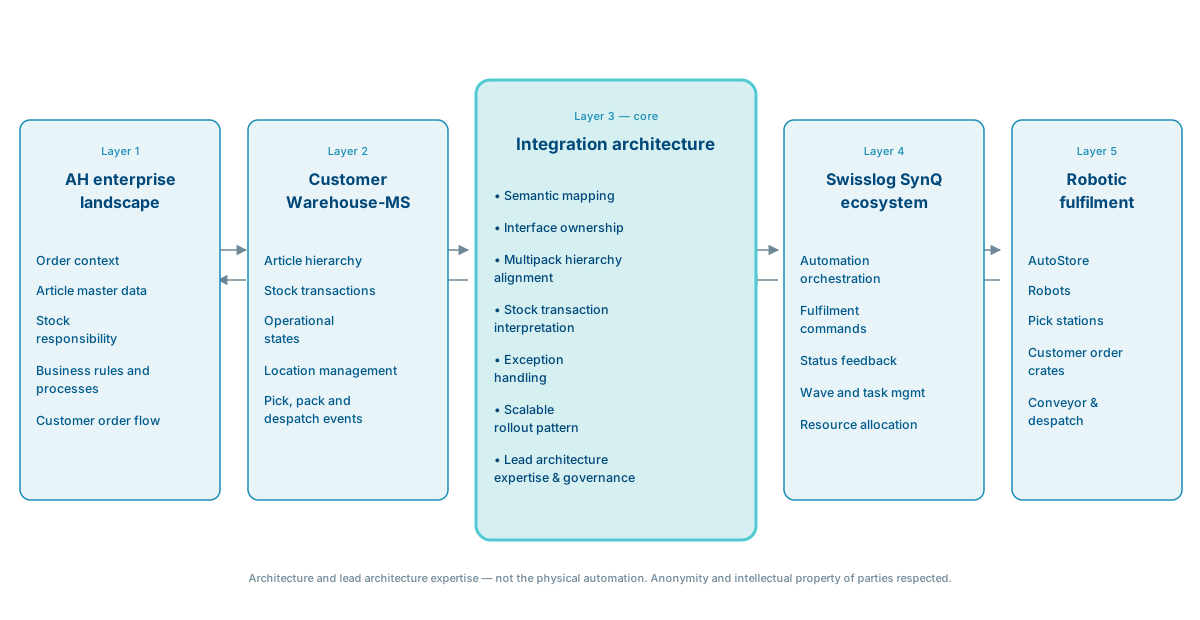
Data Conductors’ role was not the physical automation itself. Data Conductors contributed lead architecture expertise within Albert Heijn’s programme: clarifying the integration architecture, interface mappings and system responsibilities required to connect the Swisslog ecosystem to the existing Customer Warehouse Management System.
The solution and related intellectual property are owned by Albert Heijn. Data Conductors contributed the architecture expertise needed to make the integration reliable, transferable and scalable for Barendrecht, Zwolle and future Home Shop Centers.
The challenge
The complexity was not only in connecting systems, but in meaning.
The existing Customer Warehouse Management System and Swisslog SynQ used different interpretations of article hierarchies, multipack structures, stock transactions and operational states. An interface can exchange messages technically, but a fulfilment operation only becomes reliable when both ecosystems mean the same thing when they talk about articles, stock, orders and fulfilment state.
Without explicit architecture discipline, systems may be technically connected while still speaking different operational languages. That can lead to incorrectly interpreted stock transactions, unclear responsibilities, more start-up issues and a solution that is harder to scale to future locations.
Architecture approach
As Lead Architect, Data Conductors made the differences between the existing warehouse-management landscape and the Swisslog ecosystem explicit.
The approach included:
- creating a high-level architecture view;
- defining interface mappings between both ecosystems;
- interpreting article hierarchies and multipack structures;
- clarifying stock transactions and their granularity;
- making system boundaries and responsibilities explicit;
- contributing input for security risk assessment;
- guiding multiple development teams;
- documenting solution directions in Confluence for decision-making and handover;
- preparing proposals for platform design authority.
The central question was: which system is leading for which meaning, transaction and state? Only when that is clear can an integration layer be built that works technically and remains manageable operationally.
Trade-offs
The solution had to fit into an existing enterprise landscape. This was not a greenfield situation where all systems could be freely redesigned.
Choices had to be made between adapting, mapping, shielding and accepting constraints. Not every difference between systems should be solved with custom logic. Sometimes an explicit mapping is better. Sometimes a platform limitation should remain visible in the integration agreements. And sometimes the architecture must prevent local exceptions from becoming structural complexity later.
The integration layer had to support not only Barendrecht, but also be reusable for further rollout to Zwolle and future Home Shop Centers.
Result
The result was a timely and scalable integration layer between Albert Heijn’s existing Customer Warehouse Management landscape and the Swisslog ecosystem.
Robotic fulfilment was not connected as an isolated automation island, but as part of a manageable enterprise landscape. Article structures, stock transactions, operational states and interface responsibilities were made explicit, so teams could build on shared meaning instead of implicit assumptions.
What Data Conductors delivered
Data Conductors contributed lead architecture expertise at the intersection of warehouse management, integration architecture, security and delivery; this connects to IT architecture, integration and Oracle expertise.
The contribution was mainly in reducing complex system differences to concrete architecture decisions and transferable interface agreements. Data Conductors helped prevent two ecosystems from using the same words while meaning different things operationally.
The critical work was not connecting two systems. It was making sure both systems meant the same thing when they talked about articles, stock, orders and fulfilment state.
Public references
This case refers to publicly announced information about Albert Heijn’s automated Home Shop Centers and the Swisslog automation ecosystem. Data Conductors’ role is described specifically as lead architecture expertise around integration, semantic mapping and system-boundary clarification. The solution and intellectual property are owned by Albert Heijn.
- Albert Heijn — Albert Heijn en Swisslog realiseren geautomatiseerd Home Shop Center
- Albert Heijn — In nieuw Home Shop Center van Albert Heijn doen robots de boodschappen
- Swisslog — Swisslog automates new Home Shop Center of Albert Heijn in Barendrecht
- Swisslog — Swisslog and Albert Heijn unveil new automated Home Shop Center in Zwolle